When it comes to expanding a business into new markets, it often requires strategic investment to grow and scale operations. And one of the most effective ways to prepare for long-term stability is accessing funding through Equity Capital Markets.
However, it should be remembered that businesses preparing to raise capital must demonstrate strong governance, regulatory compliance, and operational readiness before approaching investors. Investors want to see clear evidence that your business is fully prepared to scale from the inside out.
In this blog post, we will look at what a company should do from a legal and governance perspective before exploring equity investment and how an experienced equity capital market advisory firm can simplify the entire compliance process.
What Exactly is Equity Capital Markets?
Equity Capital Markets represent the financial environment in which firms seek capital by issuing shares to their stakeholders in exchange for ownership. This method has been adopted in Kenya as one way companies can finance their growth and improve governance.
Take, for example, a manufacturing business. It might wish to increase its manufacturing capacity or build another plant, but it might not want to do this using borrowing alone. Rather, it could issue shares to investors and raise the capital it needs to expand, while also providing ownership interests in the company to its stockholders.
The Essential Legal and Governance Checklist for Investment Readiness
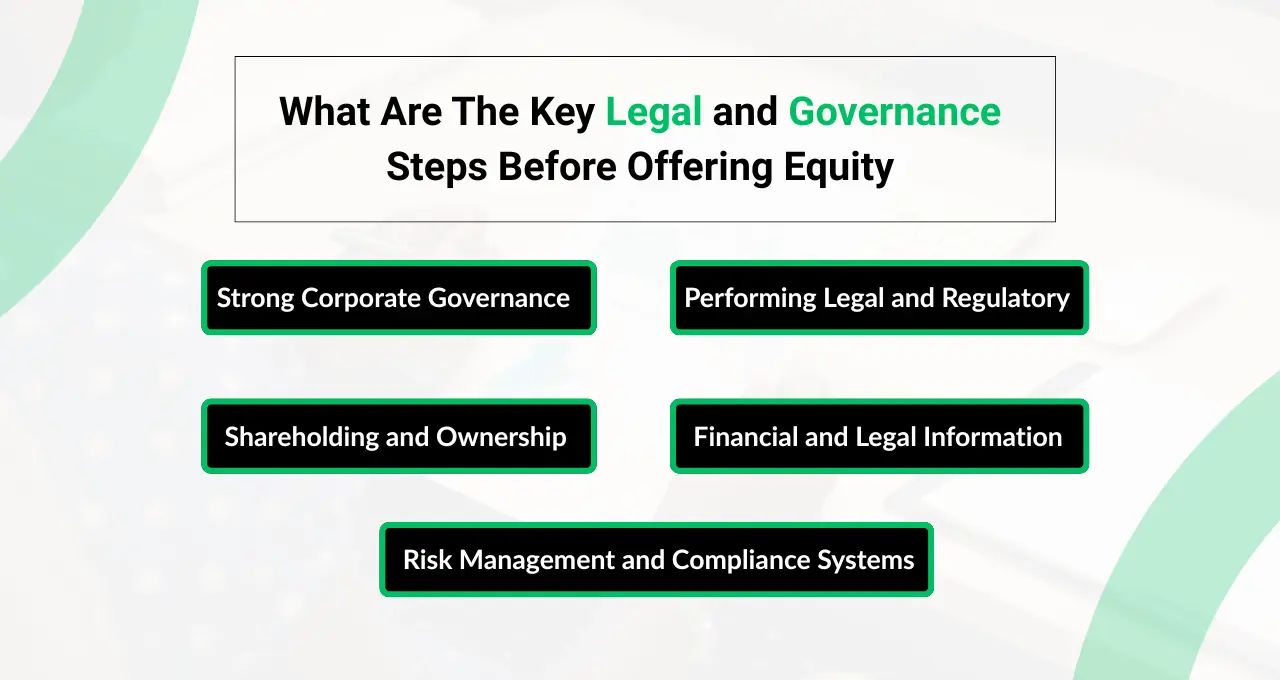
Raising capital through equity is a significant strategic undertaking for businesses at various stages of growth. However, before proceeding, it is imperative that the organisation satisfies a range of legal and corporate governance requirements. The key criteria are set out below:
1. Establishing Robust Corporate Governance Frameworks
The creation of a business governance framework is among the first things potential investors check before investing in a venture. Investors and regulatory bodies can easily see that companies with clear board oversight, defined decision-making responsibilities, and internal control procedures are accountable and professional.
Companies that invest early in building strong governance frameworks gain an advantage in earning investors’ confidence.
2. Conducting Comprehensive Legal and Regulatory Due Diligence
A company must ensure that it has undertaken a thorough assessment of its compliance with all applicable legal requirements relating to incorporation, securities regulation, and licensing prior to issuing shares to investors.
This may include obtaining the requisite regulatory approvals, depending on the structure and scale of the proposed transaction. Furthermore, the company is required to comply with all relevant securities and business laws before engaging prospective investors or offering shares for issuance
3. Evaluating the Company’s Shareholding and Ownership Structure
Where equity investment is contemplated, the company’s shareholding structure is likely to be affected. Accordingly, a comprehensive review of the existing shareholding arrangements is essential to assess the potential impact of share dilution, voting rights, and overall ownership control on the business.
Well-drafted and clearly articulated shareholder agreements are critical in defining the rights, roles, and obligations of each party, as well as establishing effective mechanisms for dispute resolution. A transparent and well-structured ownership framework enhances investor confidence and provides certainty in relation to governance and control
4. Maintaining Comprehensive Financial and Legal Records
Financial and legal information is fundamental to enabling investors to make informed assessments of prospective investment opportunities. Accordingly, businesses should ensure that all relevant documentation and financial statements are accurate, complete, and properly organised in preparation for investor engagements.
The availability of reliable and comprehensive records facilitates the early identification of potential risks and supports informed decision-making prior to the commencement of negotiations
5. Establishing Robust Risk Management and Compliance Frameworks
A robust risk management system is essential in preparing a business for equity financing. It enables the company to identify, assess, and mitigate potential risks, thereby reducing the likelihood of material adverse impacts in the future.
Such a framework typically encompasses internal control mechanisms, as well as ongoing compliance and governance reviews, all of which support the organisation in maintaining responsible and legally compliant operations
The Role of Equity Capital Markets Advisory Services
Exploring the Equity Capital Market is certainly a smart step for any business to fully expand its potential. However, meeting all legal and governance requirements is quite a complicated procedure without the right expertise. This is where businesses seek expert guidance from top Equity Capital Markets Advisory firms to help them confidently navigate. This is how they help:
- Develop structured equity financing strategies
- Ensure all legal documentation is properly structured and aligned for investor readiness
- Perform due diligence and risk assessments
- Adhere to regulatory requirements
- Enhance governance and reporting structures
Additionally, these firms support businesses with public offerings and listings, rights issues, the issuance of equity and debt, and governance compliance. This way, they ensure efficiency of processes while safeguarding the best interests of the company.
Ready to Raise Capital? Let KN Law LLP Guide Your Private Equity Journey with Confidence
At KN Law LLP, we understand what it takes for businesses to gear up for investment and growth. Our team has deep experience working with Venture Capital and Private Equity Funds, and we have helped plenty of start-ups navigate those tough early rounds and major turning points.
We have also guided clients through privatizations and big corporate restructurings, so we bring real-world insight to every project.
If you are planning to attract investors or strengthen your investment readiness, reach out today and move forward with confidence and clear direction.
FAQS
Q1. What does preparing a business for a private equity investment involve?
Preparing a business for private equity investment entails implementing a series of legal, financial, and governance measures to ensure investment readiness. This process includes strengthening corporate governance and regulatory compliance frameworks, organising and formalising financial documentation, enhancing risk management systems, and optimising the company’s shareholding and ownership structure prior to engaging with prospective investors.
Q2. Why is corporate governance necessary prior to equity financing?
Corporate governance plays a vital role in instilling investor confidence, fostering transparency, promoting regulatory compliance, and establishing sound management of investment and growth.
Q3. When should a business seek Equity Capital Markets Advisory services?
A business should consider engaging Equity Capital Markets Advisory services at key stages in its capital-raising and strategic planning process. This typically includes when the company intends to offer shares to investors, attract external capital, restructure its ownership or shareholding arrangements, or ensure compliance with applicable legal and regulatory requirements.